Automation that never leaves your process.
Duvo carries out each step by the agreed rules across your existing systems. Anything the rules do not cover goes to your team, so nothing runs outside the process.
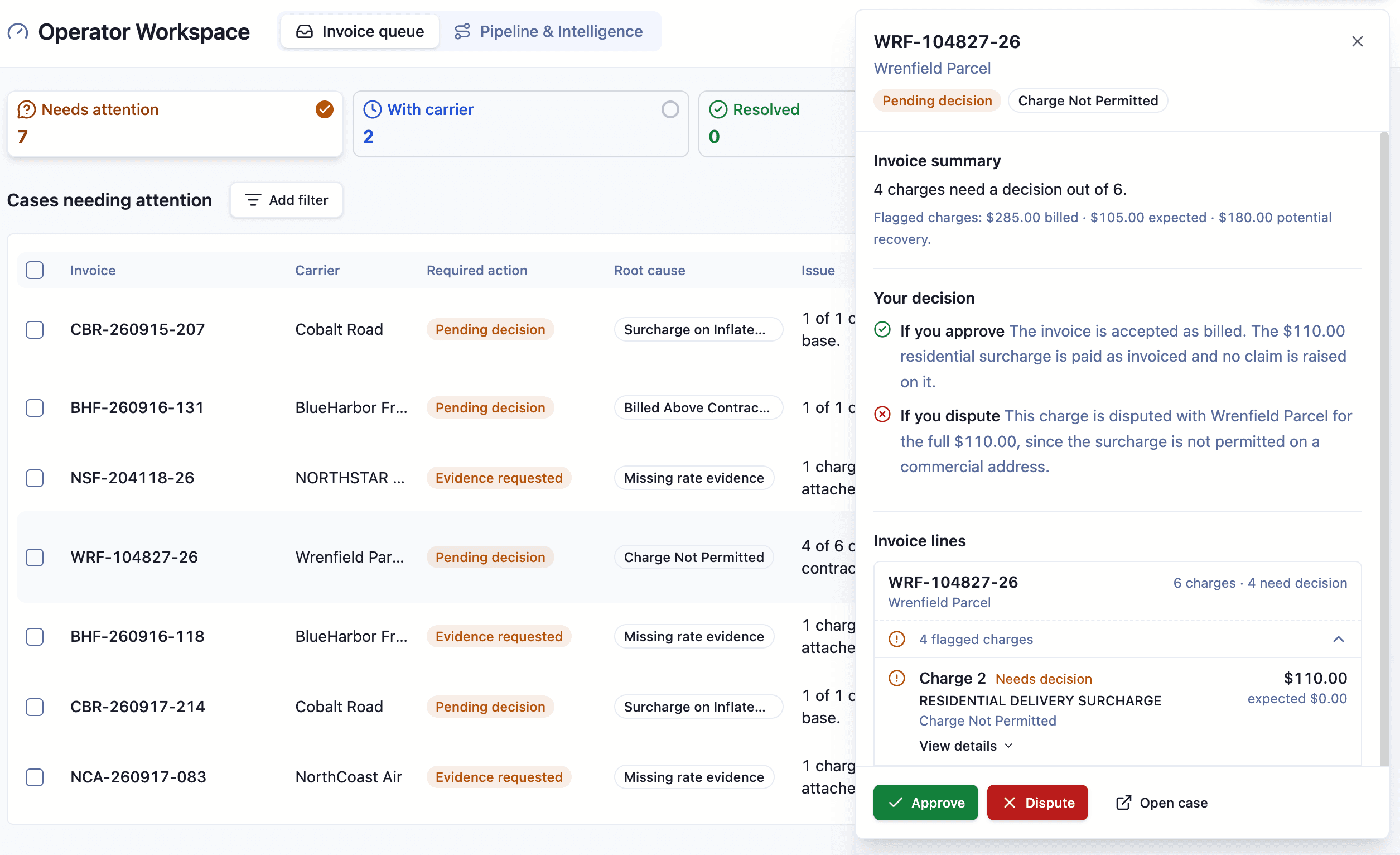
See what needs your decision.
The operator workspace lists each case by its required action: pending decision, evidence requested or with the carrier. Each row names the carrier and the root cause Duvo found.
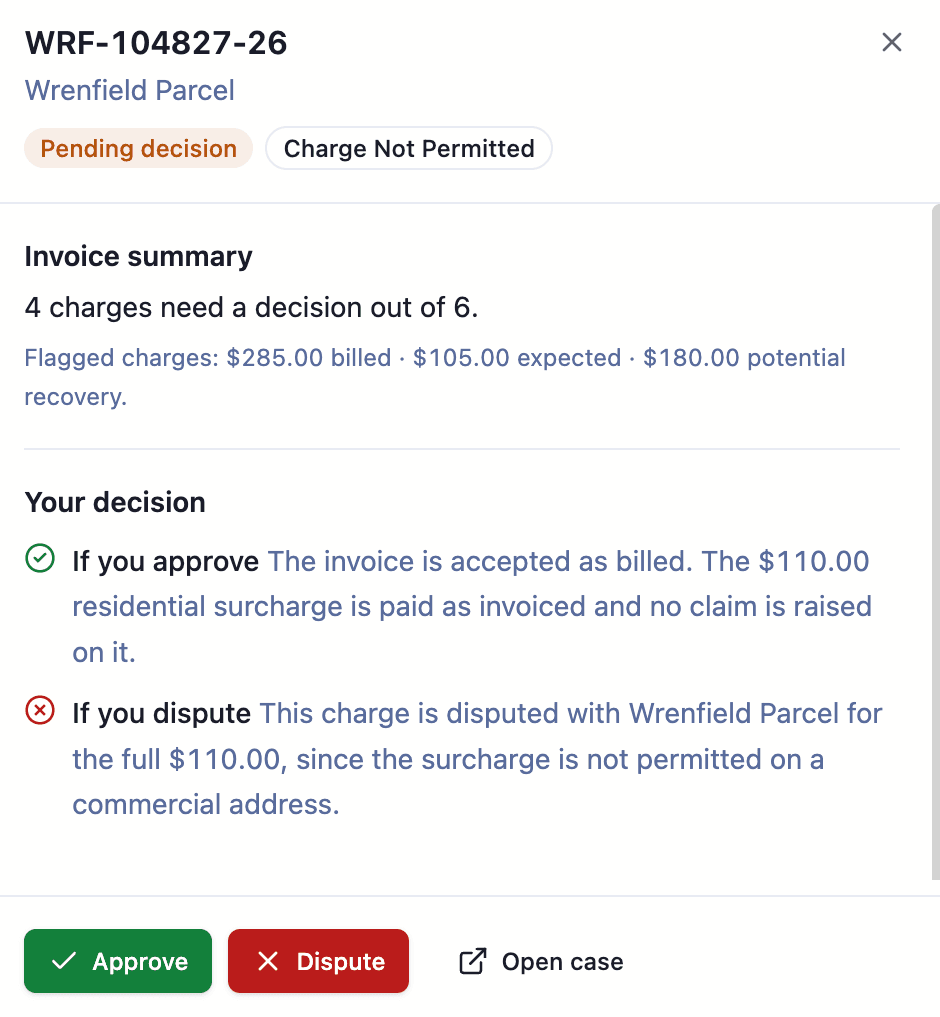
Know what each choice does.
Before you choose, the case states what happens if you approve and what happens if you dispute. Each flagged charge shows the billed amount beside the expected one.
Decide in one step.
Approve and the invoice is paid as billed. Dispute and the charge is disputed with the carrier. Open case shows the full record.
Check the recommendation before you approve.
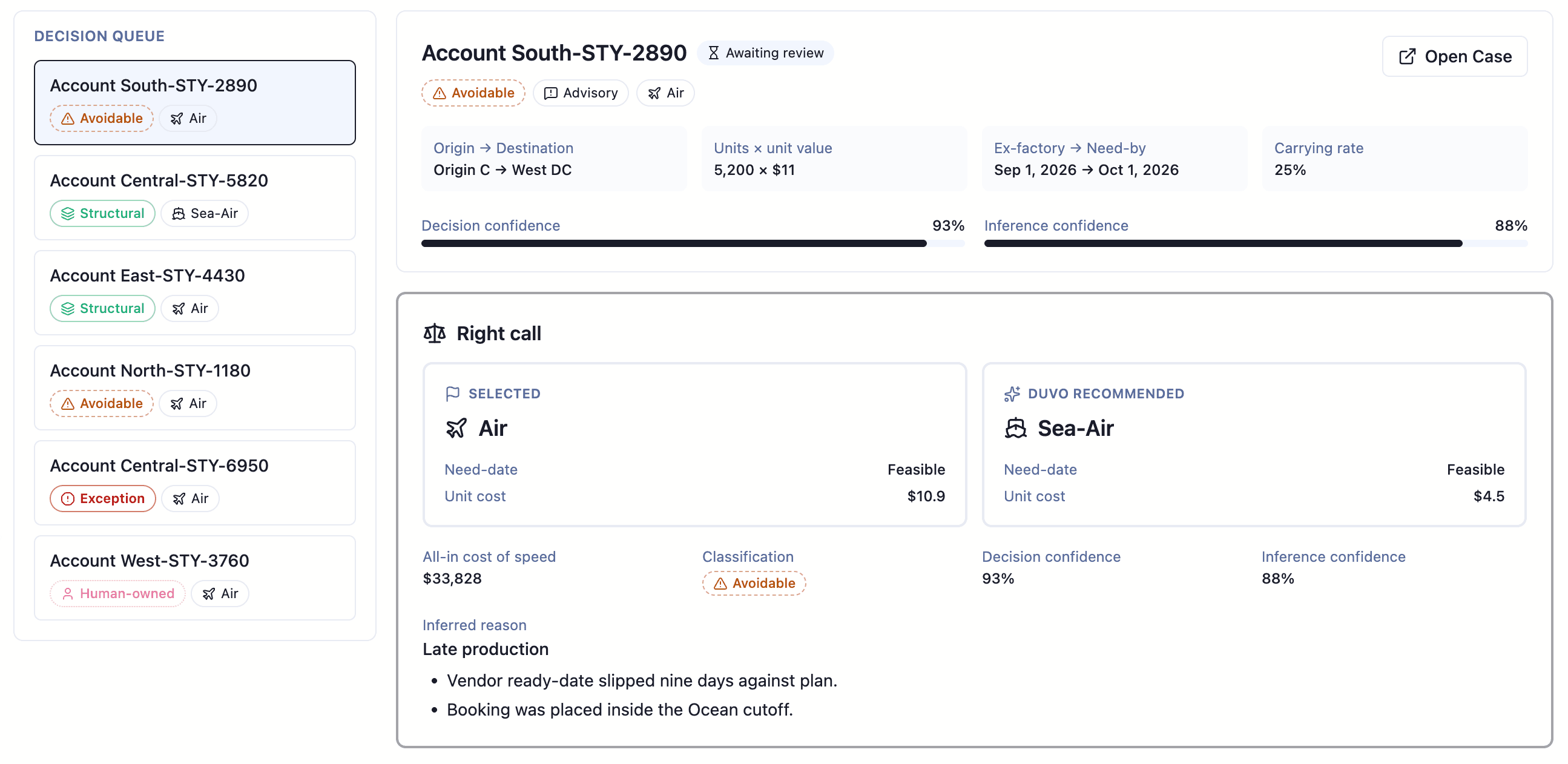
Compare the choice with the recommendation.
In this shipping-mode review, the selected mode sits beside the one Duvo recommends, with need-date feasibility and unit cost for each.
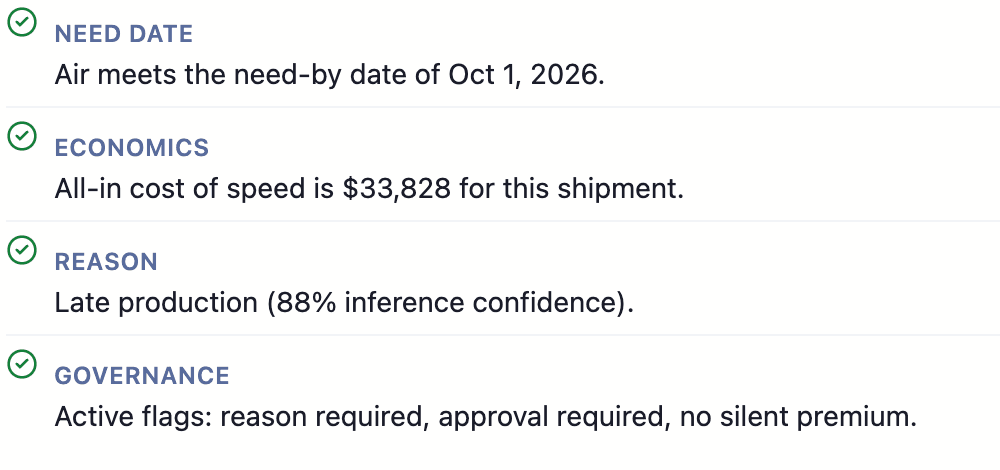
See the reason and the confidence.
Duvo infers why the faster mode was chosen, lists the evidence behind it and shows how confident it is in the call and the reason.
Sort the calls by cause.
Each shipment in the queue carries a classification: avoidable, structural, exception or human-owned. The selected call waits for your review.
Take your process live.
- 01Start from the agreed process
Review the automation proposal.
Duvo proposes how the process should run, including the steps to automate and decisions to keep with your team. Start from a new process map or one you already have.
- 02Configure the process
Duvo configures and tests the automation.
Duvo adapts a pre-built solution where it fits and connects the systems the process needs. Your team approves access and checks the results before production.
- 03Run end-to-end
Let Duvo handle the routine cases.
Duvo carries out the agreed steps and checks the results. Your team handles required decisions and exceptions, and approves changes to the process.
Keep the systems your team already uses.
Your IT team approves system access.
Use existing connections.
Duvo uses pre-built connections for systems such as SAP, Microsoft 365 and Salesforce. Bespoke connections are scoped where needed.
Work in carrier and supplier portals.
When an API does not cover a step, Duvo can use the approved web interface. Your team can take over or stop the browser session.
Include desktop and legacy applications.
Duvo can work through an approved remote desktop or terminal session when the process depends on a legacy application.
Keep your team in charge of approvals.
Who runs the process
Duvo configures the steps, connections and controls for the approved scope. Reuse the automation across teams or regions where the process is equivalent.
Changes to the process
Each agent keeps context, feedback and exception handling across runs. Changes to agreed rules and approval boundaries require process-owner review.
Approvals and exceptions
Cases move through pending, in progress, needs input, and completed. When a case needs a human, it lands with the responsible owner with the evidence attached; they resolve or delegate it, and the agent carries on. Retries and escalations are logged like every other step.
Action history
Every action, decision, and tool call is logged and replayable. Built for finance, ops, and risk sign-off from day one.
Results and time saved
Track throughput, accuracy, error rate and hours saved in Operating Insights, with business results measured against the agreed process baseline.
Live within 8 weeks, measured by outcomes delivered.
IT didn't have capacity to fix our ordering process. Duvo gave us a shortcut: it validates orders, sends improvements to Slack for approval, and executes the change directly through our internal UI. A+B availability moved 15% in two weeks. No rebuild, no new APIs.
Petr Marek, Supply Chain Manager
Pilulka
Duvo automated our supplier-term negotiations, making them seamless and auditable. We saved a month in annual processes, and freed our team for strategic tasks. The impact on our operations is profound.
Olin Novak
CRO, Rohlik Group