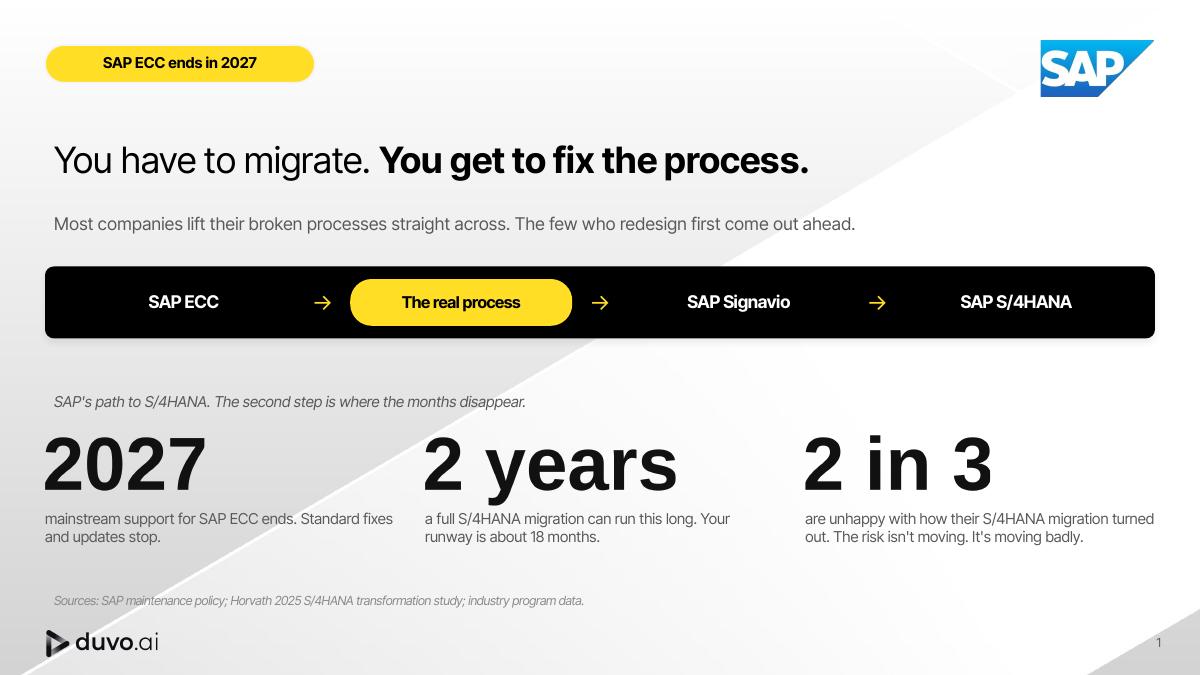
SAP stops supporting ECC in 2027. If you run it, you have to move to S/4HANA, SAP's newer ERP. Nobody is looking forward to it. These projects are long, expensive, and most of them run over.
Almost all of that pain traces back to one thing, and it is not the technology. It is the work underneath: figuring out how the business actually runs and what is worth keeping. Skip it and you drag every old workaround into the new system. Do that part first and the rest gets a lot easier.
Key Takeaways
- SAP ECC support ends in December 2027. You can pay for support through 2030, but that buys time, not a better system.
- The hard part of the move is working out how your business really runs and what is worth keeping.
- Companies that redesign their processes before they convert finish sooner, hit fewer surprises, and spend less.
 ECC
ECC The real processSignavioS/4HANA
Your 2027 deadline, and the 2030 footnote
SAP stops mainstream support for ECC on 31 December 2027. After that, standard fixes and updates stop.
There is a paid extension. You can buy support through 2030 for a premium, then a more limited form after that. So the wall is not quite as hard as it first looks. But the extension only buys time on an old system. It does nothing for the work that actually takes time: deciding how the new processes should run.
A full move can take two years. If you want to redesign rather than copy, your real runway is closer to eighteen months. The 2027 date is the easy deadline. The hard one is finding the time to design the new processes well, so start that now.
The technology is rarely the problem
Once your processes are clear, the technical conversion is quick. What eats the calendar is everything before it: mapping how the business runs today and deciding what to keep. Most teams have this backwards.
The numbers say the same thing. In a 2025 study from Precisely and ASUG, two groups that track SAP customers, changing business processes was named the single biggest barrier to the move, ahead of custom code and team resistance. Nearly two in three companies that have already moved say they went over budget or did not get the result they wanted.
Most migrations stall on a simple, human gap: nobody has a clear, current picture of how the business actually runs.
Why the usual tools stop short
Two kinds of tools promise to map your processes for the move. Both read the machine rather than the business.
System scanners
Your custom code and how it connects
Shows how the system was built, not why, or whether anyone still needs it
Process mining
Your event logs and on-screen clicks
Strong inside SAP, blind to the work that happens in email, spreadsheets, and people's heads
Duvo
The system and the people
Doesn't stop there: reads the live system in minutes, then asks the team what is worth keeping
Code shows you the system, not the business. A scanner can tell you a process exists and how it is wired. It cannot tell you that half of it is a workaround for a problem you fixed three years ago, or that the real approval happens in a side conversation the system never sees.
That gap, between what the system does and what the business needs, is exactly where the months disappear.
What a read-only look actually finds
Duvo connects to your live SAP with read-only access, with no project to run and nothing to install. Within minutes it returns a plain report of where you stand, sorted by risk. Here is a real example from one customer scan, with the identifying details removed. It is one slice of a full read-only SAP gap analysis.
Custom code, flagged
Fourteen custom product groups and nine custom materials that fall outside SAP's clean-core rule, which keeps custom code out of the system's core so upgrades stay simple. Your keep-or-cut shortlist before you scope the move.
What stops go-live
No base price on about 95% of finished goods. Supplier confirmations at 0%. The gaps that stop orders from flowing, caught early instead of on cutover weekend.
Where risk hides
Tax data only 29% complete. A seventeen-month gap in purchase-order activity, with 1,507 items left open. The kind of exposure that becomes an audit problem if it travels into the new system.
None of this is exotic. It is the everyday mess that every long-running SAP system carries. The point is to see it before you commit a budget, not after.
Redesign first, then convert
The better order is simple. Map, redesign, then build.
- 01Step 1
Map what is really there
Duvo reads the live system and talks to the people who run it. You get the real process, system and business together, not the documentation nobody has updated since 2019.
- 02Step 2
Design the better version
Duvo proposes a cleaner process and flags what to keep and what to drop. You decide, and carry forward only what earns its place.
- 03Step 3
Hand the build a clean plan
The improved process lands in SAP Signavio, SAP's tool for designing the new processes. Your build team and partner start with discovery and redesign done, instead of working it out mid-project.
This fits how serious migrations are run. SAP itself pushes a process-first approach to the move, and the build is usually delivered with a partner. Duvo does the discovery and redesign, then exports the finished process straight into SAP Signavio, so your partner builds from a clean plan instead of a guess.
Once you are live, the same habit keeps paying off. See how teams automate SAP-connected back-office work after the move.
See where you stand
You do not have to guess where the risk is. Connect your live ECC or S/4HANA to Duvo with read-only access and get a risk-rated report in minutes, measured against SAP's own migration method and clean-core guidance. It is the fastest way to learn what to fix before the move, while you still have time to fix it.
Get a read-only gap analysis and see your shortlist before you scope the project.
Frequently Asked Questions
When does SAP ECC support actually end?
Mainstream support ends on 31 December 2027. You can pay for extended support through 2030, and a more limited form after that. The deadline buys time on the old system. It does not make the move any easier.
Can I just lift and shift to S/4HANA?
You can copy your current setup across, an approach often called "brownfield." It is faster on paper, but you carry every workaround and unused custom build with you, and you inherit the same problems in a new system. Most of the redesign work just moves to after go-live, when it is harder to do.
Brownfield or greenfield: which is right?
"Brownfield" means convert what you have. "Greenfield" means rebuild fresh. The right answer depends on how much of your current setup is worth keeping. You cannot make that call well until you have an honest map of how you run today, which is the step most teams skip.
What is "clean core"?
It is SAP's guidance to keep custom code out of the system's core, so future updates stay simple and cheap. The more custom build you carry into S/4HANA, the harder every later upgrade gets. A move is the best chance to trim it.
Do I really have to redesign before migrating?
No rule forces it. But the pattern is consistent: the projects that go over budget and disappoint are usually the ones that skipped the process work. Redesigning first is how you avoid paying for the same mess twice.